


Top Emerging Towns Near Singapore You Should Look Into Before It’s Too Late
Singapore’s property market has long been one of Asia’s most expensive, with prices that make even wealthy expats think twice. As the island city-state continues its relentless march upward in cost, a quiet transformation is happening just across the border. Southern Malaysia is experiencing a development boom that’s creating opportunities reminiscent of early Singapore itself, and smart investors, expats, and families are taking notice before prices surge beyond reach.

The combination of massive infrastructure projects, special economic zones, and Singapore’s proximity is creating a perfect storm of growth potential in Malaysian towns that were once sleepy border communities. The window of opportunity remains open, but it’s closing fast. Here are the top emerging towns near Singapore that deserve your attention before the rest of the world catches on.

Johor Bahru: The Lion City’s Shadow City Coming Into Its Own
Johor Bahru has lived in Singapore’s shadow for decades, earning an unfortunate reputation as a seedy border town where Singaporeans crossed for cheap shopping and questionable entertainment. That narrative is rapidly becoming outdated as JB transforms into a legitimate metropolis with its own identity and economic power.
The Johor-Singapore Rapid Transit System, expected to launch by late 2026, will move up to 10,000 passengers per hour between Bukit Chagar in JB and Woodlands North in Singapore. This isn’t just another transport link; it’s a game-changer that will make living in JB and working in Singapore not just feasible but practical. Current commute times of 60-90 minutes through congested checkpoints will shrink to approximately 15 minutes of comfortable, air-conditioned travel.

Property prices in Johor Bahru City Centre have appreciated 40-50% since 2020, driven by urban renewal and proximity to Singapore. Yet compared to Singapore’s astronomical costs, JB remains remarkably affordable. The price per square meter in Johor Bahru’s city center is RM7,059.04, while in Singapore you’ll pay multiples of that amount. Properties near the Bukit Chagar RTS station are expected to experience significant value appreciation as the system comes online.
The numbers tell a compelling story. Over 300,000 Malaysians cross the Johor-Singapore Causeway daily, making it one of the world’s busiest border crossings. This massive flow of people demonstrates strong demand for housing near the border. For expats, Johor Bahru offers budget-friendly alternatives to Singapore’s crushing costs. A single room in Singapore costs at least SG$700-800 monthly, while in Johor, you can rent an entire 3-4 bedroom apartment for the same price.
JB’s transformation extends beyond transport infrastructure. The city is developing modern shopping complexes, international schools, and healthcare facilities that meet expat standards. Johor Bahru City Centre is leading with urban renewal initiatives, while areas like Tebrau benefit from affordability and improving connectivity to both the city center and Singapore.

Iskandar Puteri: The Planned City That’s Actually Happening
If Johor Bahru represents organic growth meeting modern planning, Iskandar Puteri represents ambition made concrete. This planned township within the Iskandar Malaysia special economic zone has evolved from concept to reality, and it’s positioning itself as a self-sufficient city rather than merely a Singapore overflow zone.
Located just 18 kilometers from the Malaysia-Singapore Second Link, Iskandar Puteri has recorded 30-40% property price growth boosted by the Johor-Singapore Special Economic Zone development and new infrastructure projects. The township won the Best Masterplan Award at the FIABCI Prix d’Excellence Awards 2012, validating its design and execution.
What sets Iskandar Puteri apart is its holistic approach to city building. EduCity, a sprawling 305-acre education hub, houses international higher education institutions including Newcastle University of Medicine Malaysia and University of Reading Malaysia, plus three international schools. This concentration of educational facilities attracts families seeking quality education without Singapore’s astronomical costs.
The township emphasizes sustainable development and renewable energy, positioning itself for future environmental standards. Major current transport projects enhance connections between districts and economic zones, with the area benefiting from the Iskandar Coastal Highway and Pasir Gudang Highway connectivity.
Real estate in Iskandar Puteri ranges from landed terrace houses and bungalons to condominiums and apartments. The median price for properties sits at RM550,000 or RM410 per square foot. Popular projects include landed properties in Taman Bukit Indah, Horizon Hills, and Nusa Sentral. Bukit Indah is particularly notable for its natural attractions, including a 20-acre park and several gardens, with average prices around RM479 per square foot.
Commercial properties showed remarkable activity with transaction volumes jumping nearly 55% in high-demand districts like Iskandar Puteri and Medini. Developer confidence remains high based on continued new project launches and sustained transaction activity throughout 2025, suggesting market fundamentals support continued price growth rather than speculative bubbles.

Medini: The Tech Hub Taking Shape
Within the broader Iskandar Malaysia region, Medini deserves special attention as a planned township focused on technology, creative industries, and innovation. This 2,300-acre development is achieving 25-35% price increases due to new commercial and residential launches in this planned township.
Medini’s strategic positioning focuses on attracting knowledge-based industries, creative enterprises, and technology companies. The master plan includes commercial centers, residential areas, educational facilities, and substantial green spaces. The township targets professionals working in these sectors, creating a community of skilled workers and entrepreneurs.
Properties in Medini offer value propositions for those seeking modern living environments with growth potential. The area benefits from Iskandar Malaysia’s broader infrastructure investments while maintaining its distinct identity as a tech-focused zone. As more companies establish operations and the ecosystem matures, Medini’s appeal will likely increase substantially.
The township’s development remains ongoing, meaning early investors and residents can benefit from price appreciation as the area continues building out its facilities and attracting businesses. This represents classic ground-floor opportunity for those willing to invest in emerging areas before they reach full maturity.
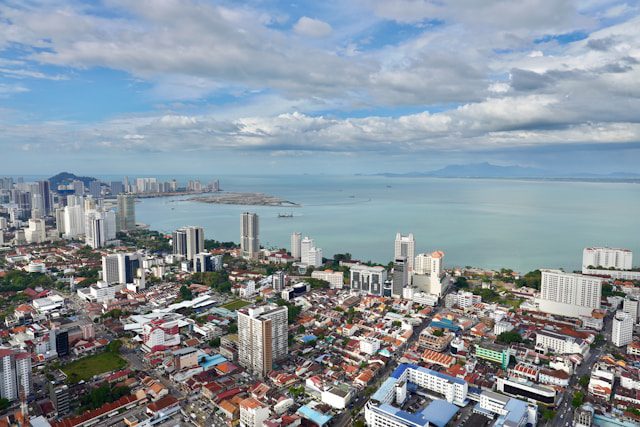
Penang: The Established Jewel Still Offering Value
While technically not adjacent to Singapore like Johor’s developments, Penang deserves inclusion for its unique position as Malaysia’s most established expat destination that still offers compelling value compared to Singapore. The island state has perfected the balance between development and livability that many emerging areas are still pursuing.
Penang’s Quality of Life Index of 154.23, favorable climate, and excellent healthcare make it a magnet for expatriates and foreign residents. The island’s vibrant culture, rich history, and culinary scene create an environment where expats don’t just live but thrive. UNESCO World Heritage George Town provides historical charm, while modern areas like Tanjung Bungah and Gurney Drive offer contemporary living.
The property market shows strong fundamentals. In the first half of 2024, Penang saw a 23.8% jump in property transaction values compared to the previous year, driven by foreign buyers targeting the residential market due to strategic location and appealing lifestyle offerings. City center rental yields are increasing, with real estate experts predicting rent growth returning to historical averages around 3.5% by mid-2025.
Penang’s MM2H advantages set it apart. The state allows MM2H visa holders to purchase residential properties for as low as RM500,000, significantly lower than other major Malaysian states. This combination of established infrastructure, lower entry points, and genuine lifestyle appeal makes Penang compelling for those seeking proven quality over frontier opportunities.
[Link: Penang Lifestyle Overview – Discover Island Living]
The limited supply and high demand in Penang’s city center mean rental prices continue rising, particularly driven by expatriates and young professionals eager to live in the heart of activity. Properties in areas like Tanjung Bungah, Tanjung Tokong, and Batu Ferringhi remain sought after, with two-bedroom homes averaging around $200,000 USD and three-bedroom homes around $300,000 USD.
Foreign buyers face restrictions but find the process manageable. Buyers need state consent and pay a 3% levy fee based on purchase price after signing sales and purchase agreements, with approval typically taking approximately 8 weeks. The process is transparent and well-established, reducing risk compared to newer development zones.
Penang’s economy thrives with strong GDP growth driven by manufacturing and a growing industrial sector. Infrastructure projects continue improving connectivity and quality of life. The number of overhang residential houses dropped from 2,901 units in 2023 to 2,400 units in 2024, indicating low vacancy rates and balanced housing supply.
[Link: Penang Real Estate Overview 2025 – Investment Insights]
Thinking about buying in Asia?
Tell us the budget, the area and roughly when you want to move. We will come back with straight answers from people who work this market every day.

The Infrastructure Catalyst: Why Now Matters
The transformation of these towns isn’t happening in isolation. Multiple massive infrastructure projects are converging to fundamentally reshape the region’s connectivity and economic integration.
The Johor-Singapore Rapid Transit System represents the most significant near-term catalyst. Expected completion by late 2026 means the window for pre-RTS investment is rapidly closing. Once the system operates, property values near stations will have already captured much of the appreciation potential.
The Johor-Singapore Special Economic Zone, officially established, aims to attract $28 billion in investments over the next decade. This isn’t speculative planning; it’s active policy with government backing from both countries. The SEZ provides tax incentives, streamlined regulations, and infrastructure investments designed to attract businesses and create employment.
Iskandar Malaysia, the broader special economic region, has already smashed its initial investment goals, hitting RM409.5 billion and targeting RM636 billion by 2030. This massive capital flow funds projects like the Kempas Interchange and Tunku Mahkota Ismail Youth Centre, transforming infrastructure and creating the foundation for sustained growth.
The Senai International Airport, while smaller than Singapore’s Changi, provides international connectivity that reduces dependence on Singapore for air travel. Direct flights to major Asian cities mean residents can travel internationally without crossing into Singapore.
These infrastructure investments create the conditions for sustainable growth rather than speculative bubbles. The fundamentals support continued appreciation: improving connectivity, government investment, business relocation from high-cost Singapore, and growing populations seeking affordable alternatives.
The Investment: Why Expats Are Paying Attention
For Singapore-based expats and those considering the region, these emerging towns present compelling opportunities across multiple use cases.
Singapore professionals can maintain employment while dramatically reducing living costs. A modest Singapore salary becomes substantially more comfortable when spent in Johor Bahru or Iskandar Puteri. The cost differential—often 60-70% cheaper for comparable accommodations—allows for significantly higher savings rates or improved lifestyle quality.
Families benefit from lower education costs while accessing international schools. The concentration of international schools in Iskandar Malaysia means children can receive quality education following familiar curricula at fractions of Singapore costs. The 34% rise in local student enrollment in international schools reflects growing recognition of these facilities’ quality.
Retirees seeking affordable Southeast Asian living find compelling options. Penang offers established expat communities and proven quality of life, while Johor provides proximity to Singapore’s world-class healthcare if needed. The MM2H program, despite recent changes, still offers pathways for long-term residence.
[Link: Singapore vs Thailand Healthcare – Which Offers the Best Deal for Expats?]
Property investors see potential for appreciation as development continues and connectivity improves. Properties near the RTS stations, within special economic zones, and in well-planned townships like Iskandar Puteri show strong potential for value growth. Rental yields in Johor Bahru average 7.29% for one-bedroom apartments, significantly higher than many established markets.
Entrepreneurs and business owners can establish operations with Singapore access but Malaysian costs. Operating expenses—labor, rent, and overhead—run substantially lower while maintaining easy access to Singapore’s business ecosystem, financial services, and international connectivity.

The Risks: What Could Go Wrong
No investment discussion is complete without acknowledging risks, and these emerging areas carry several worth considering.
Oversupply remains a legitimate concern. Evidence suggests some areas, particularly pockets of Johor Bahru, have been overbuilt with overhang units. The dual market created by foreign buyer minimums means you’re primarily selling to other foreigners, a smaller and less liquid market than the broader Malaysian market.
Currency risk affects anyone earning in Singapore dollars or other currencies while holding Malaysian assets. Ringgit fluctuations can significantly impact returns when converted back to foreign currencies. The ringgit’s historical volatility means this risk is real, not theoretical.
Regulatory changes could affect foreign ownership rules, minimum purchase prices, or tax treatments. Malaysia’s periodic policy adjustments create uncertainty, though the trend has generally favored openness to foreign investment.
Dependency on Singapore’s economic health means regional downturns affect these areas disproportionately. If Singapore’s economy slows, demand for housing in surrounding areas will likely decline. The interconnected nature of the region makes these towns vulnerable to Singapore’s economic cycles.
Construction delays and quality issues plague some developments. The rapid pace of building, particularly on reclaimed land like Forest City, can lead to structural problems. Thorough due diligence and working with reputable developers becomes essential.
Your Strategy: Matching Towns to Goals
Different emerging towns suit different priorities and strategies. Matching your goals to the right location maximizes success potential.
Choose Johor Bahru if you’re working in Singapore and want the easiest commute while maximizing savings. Properties near Bukit Chagar station offer the most straightforward lifestyle transition from Singapore.
Select Iskandar Puteri if you’re relocating with family and prioritizing education, planned community living, and modern infrastructure. The township’s holistic development appeals to those wanting established amenities rather than frontier living.
Consider Medini if you’re working in tech or creative industries and want to be part of an emerging professional community. The tech focus creates networking opportunities and career possibilities within Malaysia rather than commuting to Singapore.
Pick Penang if you want proven quality of life, established expat community, and less dependence on Singapore’s economy. The island offers the most developed lifestyle with still-reasonable prices, suitable for those prioritizing comfort and certainty over maximum appreciation potential.
Evaluate Forest City only if you’re comfortable with higher risk in exchange for potentially higher returns. The Special Financial Zone incentives could drive substantial growth, but the project’s challenges mean conservative investors should look elsewhere.
Take the Next Step: Your Malaysia Journey Starts Here
Ready to explore how Malaysia’s emerging towns can transform your lifestyle or investment portfolio? Whether you’re a Singapore professional seeking lower costs, a family wanting quality education without breaking the bank, or an investor targeting growth markets, understanding your options is crucial.
Join our exclusive Malaysia/Singapore Guide waiting list to receive comprehensive resources, insider insights, and expert guidance:
[Sign Up for the Malaysia/Singapore Guide Waiting List]
The emerging towns near Singapore represent rare combinations of government backing, infrastructure investment, and genuine growth potential. But these opportunities won’t last forever. Start planning today, and you’ll thank yourself tomorrow.
Thinking seriously about moving to Asia?
Tell us where you are now and what the move looks like. We will match you with people who have done it before and can save you the expensive mistakes.


