Long Thành International Airport: What It Means for Ho Chi Minh City’s Economy & Real Estate
Vietnam is building a second gateway for the southern mega-region: Long Thành International Airport in Đồng Nai, ~40 km east of Ho Chi Minh City (HCMC). Phase 1 targets 25 million passengers and 1.2 million tons of cargo and is being driven to completion for commercial opening in the first half of 2026, with full build-out planned toward 100 million passengers and 5 million tons of cargo in later phases. If delivery and connectivity stay on schedule, Long Thành will shift HCMC from a constrained “single-airport city” to a bi-hub system, with knock-on effects across logistics, investment, and property markets from Thủ Đức City to Nhơn Trạch and Long Thành.

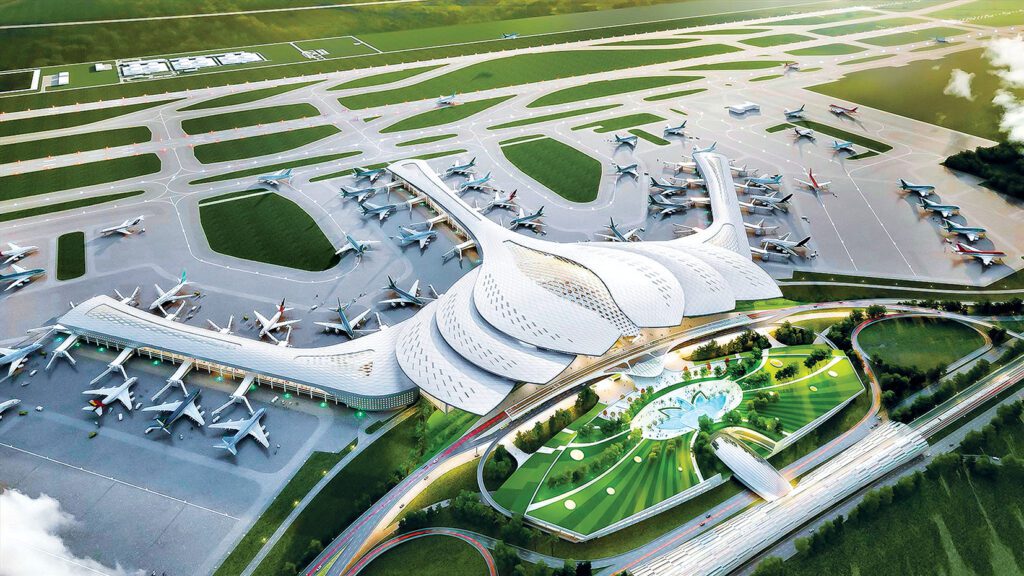
The Project in Numbers – What’s Actually Being Built
-
Location & scale: Long Thành sits in Bình Sơn, Long Thành district, Đồng Nai, approx. 40 km (25 mi) east of central HCMC, on a ~5,000–5,580 ha site. The master plan ultimately envisions four runways and multiple terminals.
-
Phase 1 (under construction): 1 runway + terminal, designed for 25m passengers / 1.2m tons cargo. Government and ministry briefings in mid-2025 reiterated basic completion in 2025 with commercial ops in H1-2026.
-
Phase 2 planning (2028–2032 window): adds an open-configuration runway + terminal to lift capacity to 50m passengers / 1.5m tons cargo.
-
Full build-out (after 2035): 80–100m passengers / up to 5m tons of cargo targeted.
-
Why HCMC needs it: Tân Sơn Nhất hit ~40–41m passengers in 2023–2024 and has faced chronic congestion; Terminal 3 (T3) opened in April 2025, raising airport capacity to ~50m—a relief valve until Long Thành comes online.

Connectivity – How People and Freight will Actually Reach Long Thành
The long-awaited Ring Road 3 stitching together Bình Dương, Đồng Nai, Long An, and the HCMC periphery; and the west–east Bến Lức–Long Thành corridor tying the airport to logistics belts and deep-water ports. As these spines open and are progressively upgraded, door-to-door times from Thủ Đức City to the terminal compress into the 30–45 minute range off-peak, while freight can flow more efficiently between factories, port gates, and the belly space of long-haul aircraft. Rail will come later, but even road alone re-maps the calculus of location for households and employers. In short: the geometry of movement tilts growth east.

-
Expressways & ring roads:
-
HCMC–Long Thành–Dầu Giây Expressway already ties HCMC’s east to Đồng Nai; widening works and interchanges are advancing.
-
Bến Lức–Long Thành Expressway sections opened through early–mid 2025, shortening travel times between Long An (west of HCMC), the city’s south, and Đồng Nai—important for port-to-airport cargo flows.
-
Ring Road 3 is slated to open to traffic by mid-2026, creating a high-capacity belt that links industrial provinces (Bình Dương, Đồng Nai, Long An) with Long Thành.
-
-
Airport approach roads in Đồng Nai: Provincial routes 25B/25C are being built to connect Long Thành with Bến Lức–Long Thành Expressway and HCMC Ring Road 3.
-
Rail (medium-term): A Thủ Thiêm–Long Thành light rail is proposed in the national plan; longer-term, Vietnam’s North–South high-speed rail (approved at concept level in 2024) could intersect the airport area, deepening regional catchment.
Bottom line: If these links deliver on time, door-to-door airport access from eastern HCMC/Thủ Đức could be 30–45 minutes off-peak, making the east-side growth corridor the practical winner.
Thinking about buying in Asia?
Tell us the budget, the area and roughly when you want to move. We will come back with straight answers from people who work this market every day.
How Ho Chi Minh City’s Aviation Map will Change
-
Short–medium term (2026–2030): Expect international long-haul and a portion of regional services to shift to Long Thành as airlines reposition hubs and belly-cargo networks. Tân Sơn Nhất—now with T3 (20m pax)—can concentrate on domestic and short-haul regional traffic, improving on-time performance for the entire system.
-
Dedicated cargo terminal works and a 1.2m-ton Phase-1 design give southern Vietnam a second main airfreight gate aligned with expressways and ports (Cát Lái, Cái Mép–Thị Vải). Expect time-sensitive exports (electronics, fashion, perishables) to benefit first.
Why it matters for business: Multinationals that have sized Vietnam as a production outpost begin to see HCMC as a base for regional services as well—finance ops, shared-services centers, product teams—because connectivity and talent pool depth converge. Over a 15–20 year horizon, those are the ingredients that shift a city from “big domestic market” to true regional hub. Vietnam’s airports handled ~109m passengers in 2024; adding a greenfield hub with room to scale reduces the friction costs that previously capped growth.

Real Estate Implications – Where Investors are Already Positioning
East HCMC / Thủ Đức City (Districts 2 & 9 + old Thủ Đức)
-
With Metro Line 1, expressway access, and Ring Road 3, Thủ Đức City has become the “heart” of new supply—municipalities cleared or green-lit >VND 30–33 trillion in projects in early 2025 alone. Expect ongoing demand for grade-A rentals, owner-occupier condos, and office/campus formats that serve airport-oriented firms.
Đồng Nai (Long Thành, Nhơn Trạch, Biên Hòa)
-
Residential: As commute times fall, long-lease landed housing and mid-market condos near the airport approaches should deepen. Early phases have seen double-digit YoY land price moves around key junctions as right-of-way and utilities come into focus (investors should vet titles and zoning carefully). Prudent filter: prefer parcels with direct frontage on planned connectors (25B/25C) or nodes near Ring Road 3 interchanges.
-
Industrial & logistics: Look for build-to-suit warehouses, cold-chain, and last-mile hubs linking Bến Lức–Long Thành to Cái Mép ports—particularly attractive for air-sea multimodal plays. The staged opening of BL-LT already shortens cargo run-times and is meant to lower OPEX for shippers.
-
Hospitality & meetings: As airlines realign, airport hotels, mid-scale business hotels, and MICE (meetings/conventions) boxes should cluster near the terminal spine—classic aerotropolis pattern seen in other hubs.
South & West corridors (Long An ↔ HCMC ↔ Đồng Nai)
-
The BL-LT Expressway unlocks “tri-provincial” site selection (factory in Long An, warehouse near BL-LT, export via Long Thành). Land banks that straddle these flows will command premiums, especially where freight restrictions and axle-load rules are favorable.
What This Means for Ho Chi Minh City
Zoom the lens out to 2040 and a coherent picture emerges. HCMC becomes a two-airport system with complementary strengths. The CBD densifies with higher-quality space and better punctuality for domestic business travel; Thủ Đức matures into an innovation and education cluster with direct highway access to the new gateway; Đồng Nai evolves into a logistics–manufacturing continuum with airport city characteristics at its core. Corridor effects replace simple distance as the determinant of value: a townhouse 25 kilometers east on a direct expressway can command a premium over an apartment half that distance but locked behind a bottleneck. In practical terms, that means investors who underwrite the corridor, not just the pin on a map, will outperform.
Where to go from here
Want curated intel on new HCMC developments positioned for the Long Thành era? Join our Vietnam Real Estate Waiting List for pre-launch updates, corridor maps, and due-diligence checklists. Read our companion feature “Ho Chi Minh City: Asia’s Next Business Hub?” exploring how Long Thành pairs with reforms, talent pipelines, and office demand to position HCMC as the region’s rising headquarters city.
Thinking seriously about moving to Asia?
Tell us where you are now and what the move looks like. We will match you with people who have done it before and can save you the expensive mistakes.