Top 10 Unique Temples in Thailand You Must Visit
The unique temples in Thailand are not just places of worship – they’re living museums of art, history, and culture. Exploring them offers a mix of spiritual insight and travel adventure, from ornate structures in bustling cities to remote shrines perched on mountaintops. Below, we highlight ten of the most unique temples in Thailand – each with its own special appeal – along with why they’re important, how to get there, and how far they are from major hubs. Enjoy a journey through Thailand’s rich cultural tapestry and plan your visit to these unforgettable sites.

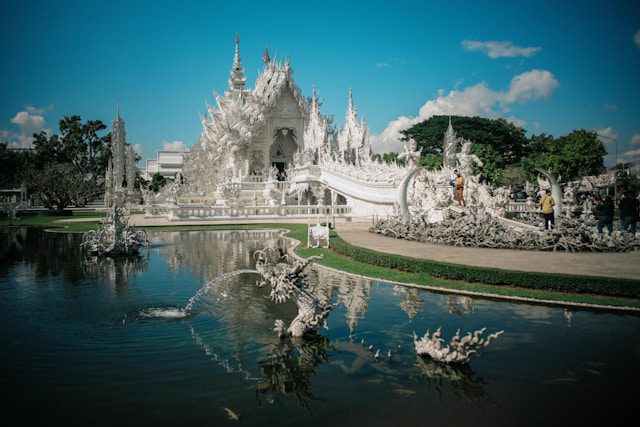
1. Wat Rong Khun (The White Temple, Chiang Rai)
Wat Rong Khun is one of the most unique temples in thailand you’ll see – a modern masterpiece of gleaming white architecture that feels straight out of a fairy tale. Designed and built by Thai artist Chalermchai Kositpipat in 1997, this privately owned temple is an art exhibit in the form of a Buddhist temple, famous for its startling white façades and intricate mirrored mosaics. The symbolism is rich: the bridge over a sea of outreaching hands represents the cycle of rebirth, and inside you’ll even find unconventional murals (spot superheroes and movie characters woven into Buddhist imagery!). Wat Rong Khun has quickly become one of Chiang Rai’s most visited attractions, blending spirituality with contemporary art
Getting there is easy – the White Temple is located about 13 km south of Chiang Rai City (roughly a 20–30 minute drive). If you’re in Chiang Rai, you can hire a tuk-tuk or taxi, or even hop on a local bus from the central bus station which stops near the temple gates. Many travelers also visit on a day trip from Chiang Mai (it’s around 3 hours by road). Chiang Rai’s airport is about 25 km away, and from there it’s a quick car ride to Wat Rong Khun. With its otherworldly beauty and artistic flair, the White Temple is a must-see for anyone visiting Thailand’s north.
Related: Chiang Rai Travel Guide (Northern Thailand’s Cultural Charms)

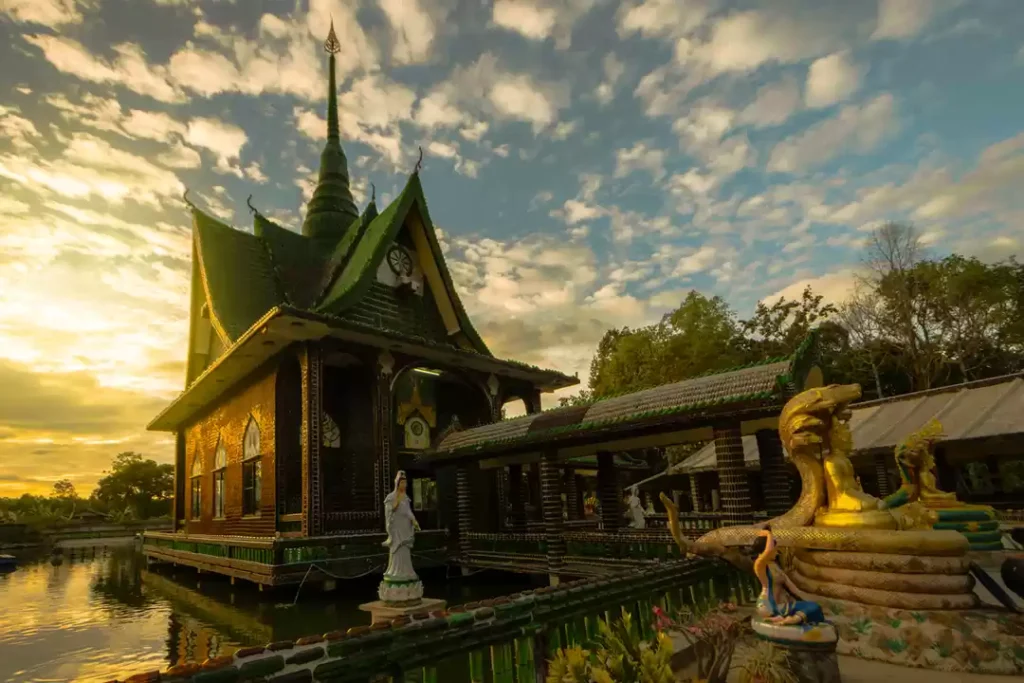
2. Wat Pa Maha Chedi Kaew (Temple of a Million Bottles, Sisaket)
Deep in Thailand’s rural northeast stands Wat Pa Maha Chedi Kaew – better known as the “Temple of a Million Bottles.” True to its nickname, this eco-friendly temple complex is constructed from over 1.5 million recycled glass bottles of green Heineken and brown Chang beer! Monks began collecting bottles in 1984 to beautify their forest temple and promote environmental awareness. The result is a stunning and quirky collection of buildings (about 20 structures including prayer halls, pagodas, even bottle-built toilets) all glittering with glass – an incredible testament to sustainability and creativity. Sunlight filtering through the bottle walls creates a serene, emerald glow inside. Wat Pa Maha Chedi Kaew isn’t just a gimmick; it’s a functioning Buddhist temple where locals come to worship, but it has also become a symbol of eco-conscious innovation admired worldwide.
Reaching this unique temple requires a bit of effort. It’s located in Khun Han district of Sisaket province, about 50–60 km south of Sisaket town (approximately a 1-hour drive). From Bangkok, it’s a long journey – Sisaket is roughly 500 km east (a 7–8 hour drive or overnight train). The nearest city with an airport is Ubon Ratchathani, about 90 km away. Travelers typically fly or train to Ubon or Sisaket, then hire a car or local taxi to the temple. Public transport is sparse in this rural area, so a private car or guided trip is recommended. The off-the-beaten-path trek is worth it – you’ll be rewarded with one of Thailand’s most bizarre and fascinating temples, where discarded bottles have been transformed into a work of art and devotion.
Related: Northeast Thailand’s Hidden Gems (Isan Cultural Adventure)
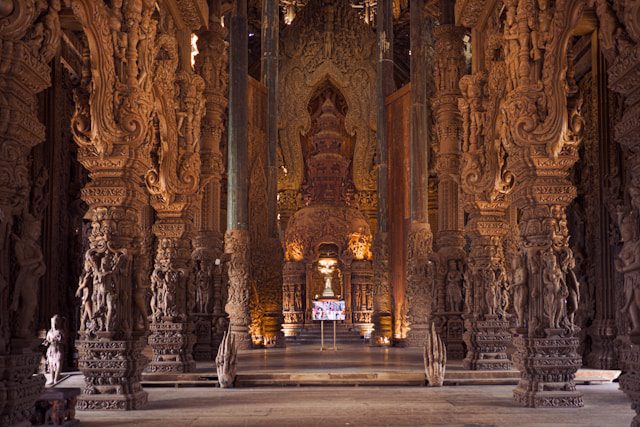
3. Sanctuary of Truth (Pattaya, Chonburi)
Rising like a wooden palace by the Gulf of Thailand, the Sanctuary of Truth is a jaw-dropping all-teak monument on the outskirts of Pattaya. Neither ancient nor exactly a traditional temple, this 105-meter-tall structure is an ongoing project (started in 1981, slated for completion around 2050) that serves as part temple, part museum, and part art installation. Every inch of the Sanctuary is covered in intricate hand-carved sculptures depicting Hindu and Buddhist motifs – and amazingly, not a single nail is used in the construction. It’s built in the style of old Siamese woodworking, using interlocking joinery to hold massive teak timbers together. Stepping inside feels like entering a giant wooden cathedral where philosophy, religion, art, and culture converge. The carvings honor Eastern spiritual teachings and human values, making the Sanctuary a place for reflection as much as photography.
Located in North Pattaya (Naklua) right by the sea, the Sanctuary of Truth is about 8 km from central Pattaya – roughly a 20-minute drive from popular beach areas. Songthaews (shared pick-up taxis) or motorbike taxis can take you there easily from town. If coming from Bangkok, Pattaya is about 150 km to the southeast; driving from Bangkok’s Suvarnabhumi Airport or city center takes around 2 hours. Many visitors make it a day trip from Bangkok or combine it with other Pattaya sights. Do note there is an entrance fee (the proceeds support the maintenance and continued building work). Visiting the Sanctuary of Truth is a unique experience – you get to witness artisans actively carving wood on-site, and you’ll marvel at the fact that this entire complex is built entirely of wood, a living work of art that you can walk through. Don’t forget to enjoy the sea breeze and views of the bay from the Sanctuary’s grounds.
Related: Pattaya’s Lifestyle Appeal (Beyond the Beach and Nightlife)
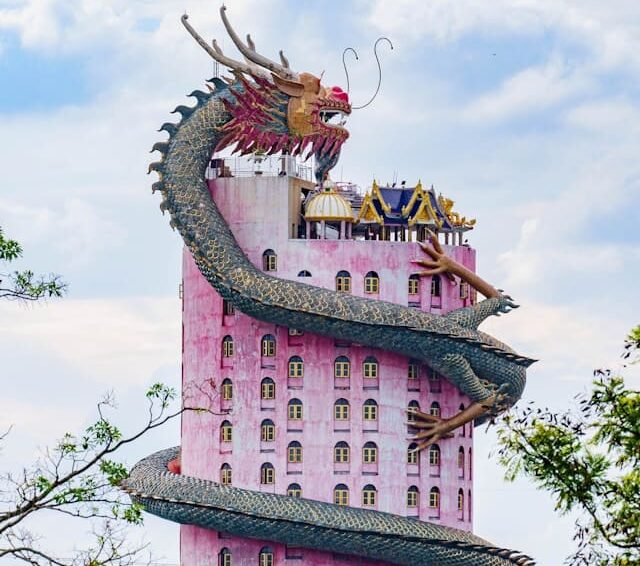
4. Wat Samphran (The Dragon Temple, Nakhon Pathom)
Just west of Bangkok hides a temple that looks like something from a fantasy novel – Wat Samphran, famously known as the “Dragon Temple.” This striking pink cylindrical tower soars 17 stories high with a gigantic green dragon spiraling around it from base to top, as if protecting a magical lair. The dragon’s scaly body actually contains a staircase (though it’s not always open to climb all the way up). Wat Samphran’s unusual design sets it apart from any other temple in Thailand – it was reportedly built in the 1980s, though it remained relatively obscure until photos of it went viral on the internet. The temple grounds also feature other fantastical statues like giant turtles and rabbits, adding to the whimsical atmosphere. Despite its internet fame, Wat Samphran is a real place of worship for the local community, so visitors are asked to dress modestly. It’s a fantastic blend of religious devotion and imaginative architecture – truly a unique temple experience for travelers and Instagrammers alike.
Wat Samphran is located in Sam Phran district of Nakhon Pathom province, about 40 km west of Bangkok’s city center. By car or taxi, it’s roughly a 1-hour drive from downtown Bangkok (depending on traffic). The temple can be a bit tricky to reach by public transit: one option is taking a bus or van toward Nakhon Pathom and getting off along Highway 4, then hiring a motorbike for the last few kilometers. The simplest way is to hire a taxi/Grab car for a half-day – many Bangkok drivers are now familiar with “Dragon Temple” trips. If you do use a ride-share, consider arranging for the driver to wait, as finding a return ride in that area can be difficult. Don Mueang Airport is about 60 km away and Suvarnabhumi Airport about 80 km, so driving from either would take 1–2 hours. Despite being just outside Bangkok, Wat Samphran feels a world apart – a hidden gem that’s perfect for a short excursion to witness one of Thailand’s most fantastical temples.
Related: Bangkok’s Lifestyle Appeal (Urban Culture and Hidden Treasures)
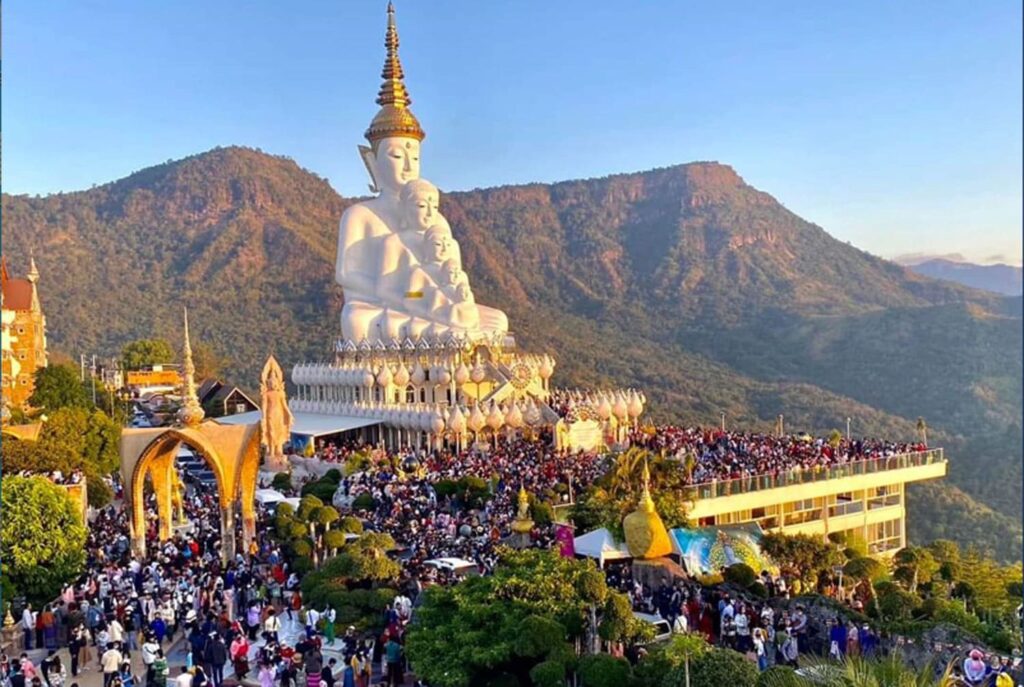
5. Wat Phra That Pha Sorn Kaew (Phetchabun)
High in the misty mountains of Phetchabun, northern Thailand, sits Wat Phra That Pha Sorn Kaew – a temple complex that is as visually stunning as its surroundings. Perched at 830 meters above sea level on a mountaintop, this monastery is renowned for its breathtaking 5-white-Buddha statue seated in a row and its main pagoda covered in over 5 million colorful mosaic tiles and pottery pieces. Every surface of the temple sparkles with glass and ceramic, creating kaleidoscopic patterns that gleam in the sunlight. Completed in the late 2000s, Wat Pha Sorn Kaew (whose name means “temple on a glass cliff”) has quickly become a highlight of the region for its unique architecture – it’s often compared to Antoni Gaudí’s style for its wild colors and shapes. The serene backdrop of rolling green hills and often mist-cloaked valleys only adds to the magic. Visiting in the early morning, you might even find the temple emerging from clouds – a truly spiritual and scenic experience.
Wat Pha Sorn Kaew is located in Khao Kho district of Phetchabun province, roughly halfway between the towns of Lom Sak and Phitsanulok. It is remote – about 400 km north of Bangkok, or a 5 to 6-hour drive by car. The nearest city with an airport is Phitsanulok, about 120 km (2 hours’ drive) away. Because it’s hard to reach by public transport, most travelers come by private car or on a guided tour. If you’re driving from Bangkok, you’ll head north via Highway 1 and 21 (approx. 5 hours). From Phitsanulok or Phetchabun town, it’s about 60–70 km up winding mountain roads. There is no direct bus to the temple – you’d need to take a bus to Khao Kho or Lom Sak and then hire local transport, which can be inconvenient. Once there, however, you’ll find parking and facilities for visitors. The effort is well rewarded: Wat Pha Sorn Kaew is often cited among Thailand’s most beautiful and unique temples, combining a peaceful spiritual vibe with an almost fantastical artistic design. Plan to spend time soaking in the 360-degree views of forested mountains and enjoying the detailed mosaics up close – this gem of Phetchabun is a feast for the eyes and soul.
Related: Northern Thailand’s Spiritual Trails (A Journey through Mountain Temples)

6. Wat Chaloem Phra Kiat (Floating Pagodas Temple, Lampang)
Imagine a cluster of white pagodas perched atop jagged grey mountaintops, seemingly floating in the sky – that’s the surreal sight awaiting visitors at Wat Chaloem Phra Kiat (officially Wat Chaloem Phra Kiat Phrachomklao Rachanuson) in Lampang province. Often dubbed the “floating pagodas” or “sky temple,” this site remained relatively unknown until photos of its cliff-top stupas went viral a few years ago. The temple’s gleaming white chedis sit at around 815 m elevation on Doi Pu Yak mountain, and reaching them requires a bit of adventure. Visitors must take a steep 4×4 pickup ride and then hike up hundreds of steps – but the payoff is incredible. At the summit, you’ll find a small shrine, multiple pagodas built by devoted monks and locals, and a panoramic 360° view of Lampang’s countryside that will leave you breathless (both from the climb and the beauty). The pagodas were constructed over a decade (completed around 2004) by an abbot and local volunteers, who carried materials up by hand – knowing that adds even more awe as you stand beside them. When the sky is clear, the contrast of the white stupas against bright blue is spectacular; when it’s cloudy, they truly appear to float on clouds. This is a hidden gem and one of Thailand’s most photogenic sacred sites.
Wat Chaloem Phra Kiat is in a rural part of Lampang province (northern Thailand), about 60 km north of Lampang city in the Chae Hom district. Getting there on your own is possible but involves mountain roads. From Lampang city (which itself is about 100 km southeast of Chiang Mai), it’s roughly a 1.5 hour drive. There is no public bus all the way to the temple, so most travelers either rent a car/motorbike or hire a local driver or tour from Lampang or Chiang Mai. Once you reach the park entrance, you’ll park and buy a shuttle ticket – visitors are ferried up a steep 5 km road in songthaew trucks (10–15 minute ride) to the trailhead. From the drop-off point, it’s about a 30-minute uphill trek (around 300 m of relatively gentle path and then ~500 m of steep stairs) to reach the summit pagodas. Sturdy shoes and moderate fitness are recommended. Chiang Mai’s international airport is the closest major airport (~3 hours drive to the temple). It’s best to visit in the morning for cooler weather and clearer views. When you finally stand among those clifftop pagodas, you’ll understand why this temple is considered one of Thailand’s most breathtaking secrets – a place where devotion quite literally reached new heights.
Related: Northern Thailand Off the Beaten Path (Lampang & Beyond)

7. Wat Phu Tok (Bueng Kan)
For thrill-seekers and serenity-lovers alike, Wat Phu Tok offers an experience few temples can match. Located in Thailand’s far northeastern corner, this temple is built on and around a lone sandstone mesa known as Phu Tok (meaning “isolated mountain”). The standout feature here is a network of rickety wooden walkways clinging to the cliffs, spiraling up seven levels around the rock formation. These narrow, wooden plank paths – with sheer drop-offs in places – are certainly not for the acrophobic, but they provide absolutely stunning views of the surrounding forests, lakes, and farmland. Wat Phu Tok is a meditation retreat founded by the revered monk Ajahn Juan in the 1960s, and the seven levels symbolize the seven factors of enlightenment in Buddhist philosophy. As you ascend, you’ll encounter meditation cells, shrines tucked in cliff crevices, and a famous giant rock balanced seemingly precariously (a bit like a smaller Kyaiktiyo Pagoda of Myanmar). Reaching the top (Level 7) is both an achievement and a spiritual journey – the summit has a small forest plateau considered sacred. The atmosphere is peaceful and a bit eerie (especially if you’re the only visitor), and the construction, though sturdy, has a rustic, adventurous feel – making Wat Phu Tok one of Thailand’s most exciting and unique temple sites.
Wat Phu Tok is in Bueng Kan province, near the Lao border. It’s quite remote – roughly 190 km (3 hours) from Udon Thani (the nearest big city and airport), and a similar distance from Nakhon Phanom or Nong Khai. There is no train service this far northeast, so most visitors come by car. If you’re not self-driving, you can take a bus to Bueng Kan town (the provincial capital) and then hire local transport for the 50 km to Phu Tok. Many guesthouses in Bueng Kan can arrange a car and driver for a day trip. From Bangkok, Bueng Kan is over 750 km – flying to Udon Thani and driving is the easiest route. Do note that public transport is virtually nonexistent directly to the temple, so planning ahead is key. At the site, a short hike up stairs leads you to the first levels; from there, be prepared for steep wooden staircases and balconies – wear good shoes and take water. There’s no entry fee, but donations are appreciated, and modest attire is expected as monks do live and meditate here. The best time to visit is in the cooler months (Nov–Feb) when the heat is less intense for climbing. Visiting Wat Phu Tok is truly venturing off the tourist trail – it offers the chance to encounter Thailand’s wilderness and spirituality all in one, through an unforgettable climb up the “ladder to heaven.”
Related: Offbeat Isan Adventures (Exploring Thailand’s Far Northeast)

8. Wat Tham Suea (Tiger Cave Temple, Krabi)
If you’re up for a challenge and a view to remember, head to Wat Tham Suea in Krabi, southern Thailand. Known as the Tiger Cave Temple, this site is famous for its strenuous climb of 1,237 steps up a limestone cliff to reach a mountaintop shrine. At the summit, you’ll find a gilded Buddha statue, a small pagoda, and a terrace that offers panoramic vistas of Krabi’s spectacular landscape – think lush rainforests, dramatic karst mountains, and the Andaman Sea glimmering in the distance. The name “Tiger Cave” comes from a legend that a tiger once lived in the cave at the foot of the hill (and you can visit the cave where tiger paw prints are said to be imprinted on the walls). Monkeys frequent the lower temple grounds, so mind your belongings, but they add to the fun. Besides the peak, Wat Tham Suea is an active meditation center – in the surrounding forest, monks and nuns live in peaceful kutis (huts) and limestone caves. The feeling at the top is one of triumph and tranquility; many consider the sweeping 360° view the best in Krabi province. Just be sure to start your ascent early or late in the day to avoid the midday heat – and bring water!
Wat Tham Suea is conveniently located about 9–10 km northwest of Krabi Town (15–20 minutes by car). It’s also only 8 km from Krabi International Airport – so close that some energetic travelers even stop here during a layover! From Krabi Town or nearby Ao Nang Beach (which is ~18 km away), you can reach the temple by songthaew (blue public truck) or by hiring a taxi. The site is well signposted from the main road (Highway 4). There’s ample parking if you drive yourself or ride a scooter. Entry is free, though donations are welcome. The base of the temple features a picturesque courtyard with the tiger cave, a large chedi, and various statues – nice to explore before or after your big climb. The hike itself can take anywhere from 30 minutes to an hour depending on your fitness (and number of rest stops!) – the steps are numbered, and yes, there are exactly 1,237 steps to the top, some extremely steep. But once you conquer them, you’ll be rewarded by a cool breeze and an unforgettable view of Krabi’s emerald panorama. This mix of physical challenge and spiritual destination makes Tiger Cave Temple a highlight for many travelers in the south.
Related: Krabi’s Lifestyle Appeal (Beaches, Adventure & Culture in Southern Thailand)
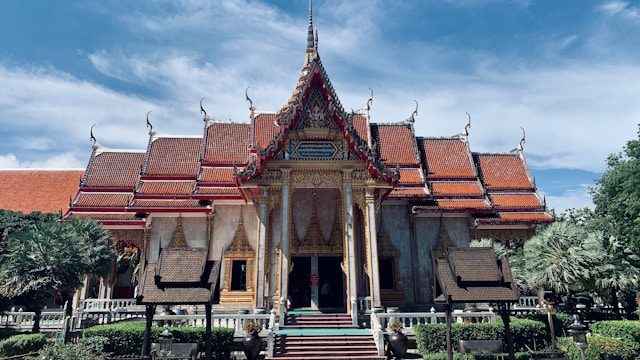
9. Wat Chalong (Wat Chaiyathararam, Phuket)
Wat Chalong is Phuket’s largest, most revered temple – a beautiful Buddhist monastery that has been the spiritual heart of the island for over a century. For visitors, it’s a must-see to understand Phuket’s culture. The temple’s architecture is classic Thai: elegant multi-tiered roofs with golden nagas, a grand prayer hall, and a striking 60-meter-tall chedi (stupa) that dominates the skyline. Inside that chedi, known as the Phra Mahathat Chedi, lies Wat Chalong’s greatest treasure: a fragment of a bone relic of the Buddha, brought from Sri Lanka – which makes this temple especially sacred. As you wander the grounds, you’ll also encounter life-like wax statues of revered monks, including Luang Pho Cham and Luang Pho Chuang, who are credited with helping Phuket’s locals during a 19th-century rebellion. Locals come to pray and light firecrackers in a brick furnace as an offering (don’t be startled by the loud bangs – it’s a tradition for giving thanks when wishes are granted!). The atmosphere is lively yet spiritual, especially on weekends or during temple fairs. With its ornate carvings, lotus ponds, and countless Buddha images, Wat Chalong offers a wonderful glimpse into Phuket’s Buddhist heritage amidst an island known more for its beaches.
Located in the central part of Phuket Island, Wat Chalong sits about 8 km south of Phuket Town and roughly 16 km from Patong Beach (the island’s main tourist beach). From Phuket City (Old Town) it’s a 10-15 minute drive. You can easily get there by local bus (the pink open-air buses that run between Phuket Town and the southern beaches will drop you near the temple) or by renting a scooter/taxi. Phuket’s International Airport is in the north of the island, about 37 km away, and driving from there takes around 45 minutes to an hour. The temple is just off Chaofa Road, en route to Chalong Circle – a well-known area, so any local transport will know it. Entry is free and the temple is open to visitors during daylight hours (generally 7am to 5pm). As always, dress modestly (cover shoulders and knees) when visiting. Wat Chalong can get busy with tour groups around mid-day, so morning or late afternoon visits are more peaceful. Whether you’re seeking merit or simply marveling at the beauty, Wat Chalong is an unmissable stop in Phuket – a place where you can experience the island’s soul beyond the sands, and maybe even catch a festive fair or hear the crackle of celebratory firecrackers echoing through the grounds.
Related: Phuket’s Lifestyle Appeal: Southeast Asia’s Luxury Retirement Haven
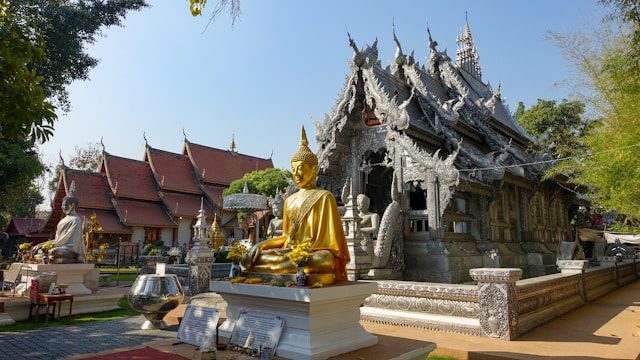
10. Wat Sri Suphan (The Silver Temple, Chiang Mai)
Tucked away in Chiang Mai’s old silversmith quarter is Wat Sri Suphan, fondly known as the Silver Temple – and one look will tell you why. The main ordination hall (ubosot) of this temple is completely covered in silver and gleaming metalwork, from the roof down to the elaborate reliefs on its walls. Every surface shines with aluminum, nickel, and silver adornments, hand-crafted by local artisans. Intricate repoussé engravings depict Buddhist cosmology, mythical creatures, and Lanna motifs, turning the building into a gigantic piece of jewelry. By day it’s impressive, but by night, illuminated by spotlights, the Silver Temple looks truly magical. Wat Sri Suphan was originally built around the 1500s during the Mangrai dynasty (making it over 500 years old), but the dazzling silver chapel was a recent project completed in the 2000s to honor and preserve the silversmith tradition of the Wua Lai community. It’s important to note: women are not allowed inside the silver ubosot due to ancient religious custom (since it’s a consecrated ordination hall). However, anyone can admire it from the outside and explore the rest of the temple grounds, which include a meditation hall, monk school, and silver craft workshops where you can watch artisans at work. In the evenings (usually on certain days) the temple often hosts monk chats or even nighttime chanting sessions, during which the silver hall glows serenely. Wat Sri Suphan offers a one-of-a-kind blend of spirituality and local art – it’s the only silver-covered temple in Thailand, and a true Chiang Mai gem.
Wat Sri Suphan is conveniently located on Wualai Road in Chiang Mai, just south of the old city walls. It’s in the traditional silver crafting district, about a 10-minute walk from Chiang Mai Gate. If you’re exploring Chiang Mai’s city center, you can reach Wat Sri Suphan easily by tuk-tuk or even on foot during the Saturday Walking Street Market (Wualai Road is the site of the lively Saturday night market). Chiang Mai International Airport is only ~3 km away, so it’s a quick 10-15 minute drive to the temple if you’re heading there straight upon arrival. No complicated transit needed – just tell any taxi “Silver Temple, Wualai Road.” There’s a small entry fee for foreigners (used for the temple’s upkeep and crafts training), and they provide sarongs if you need to cover up. While women cannot step inside the ubosot, you can still peek at the interior from the door – the interior is just as dazzling, with a large silver Buddha and colored lights. Don’t miss the display boards explaining the meaning of the engravings and the history of the temple’s renovation. Visiting Wat Sri Suphan is a chance to appreciate Chiang Mai’s famed craftsmanship in a sacred context. It’s especially recommended in the late afternoon or evening when the temple is quieter and the silver reflects the dimming light – an utterly enchanting sight that captures the essence of Chiang Mai’s creative spirit.
Related: The Ultimate Guide Chiang Mai’s Lifestyle For Nomads, Expats, Retirees
Each of these ten temples showcases a different facet of Thailand’s rich cultural and spiritual heritage. From north to south, from mountaintop marvels to artistic creations, Thailand’s unique temples offer travelers not just beautiful sights, but meaningful experiences and connections to local traditions. Whether you’re seeking stunning architecture, a bit of adventure, or a moment of peace, these sacred places are well worth the journey. Enjoy your temple hopping, and sabai dee – may your travels in Thailand be filled with wonder and enlightenment!